
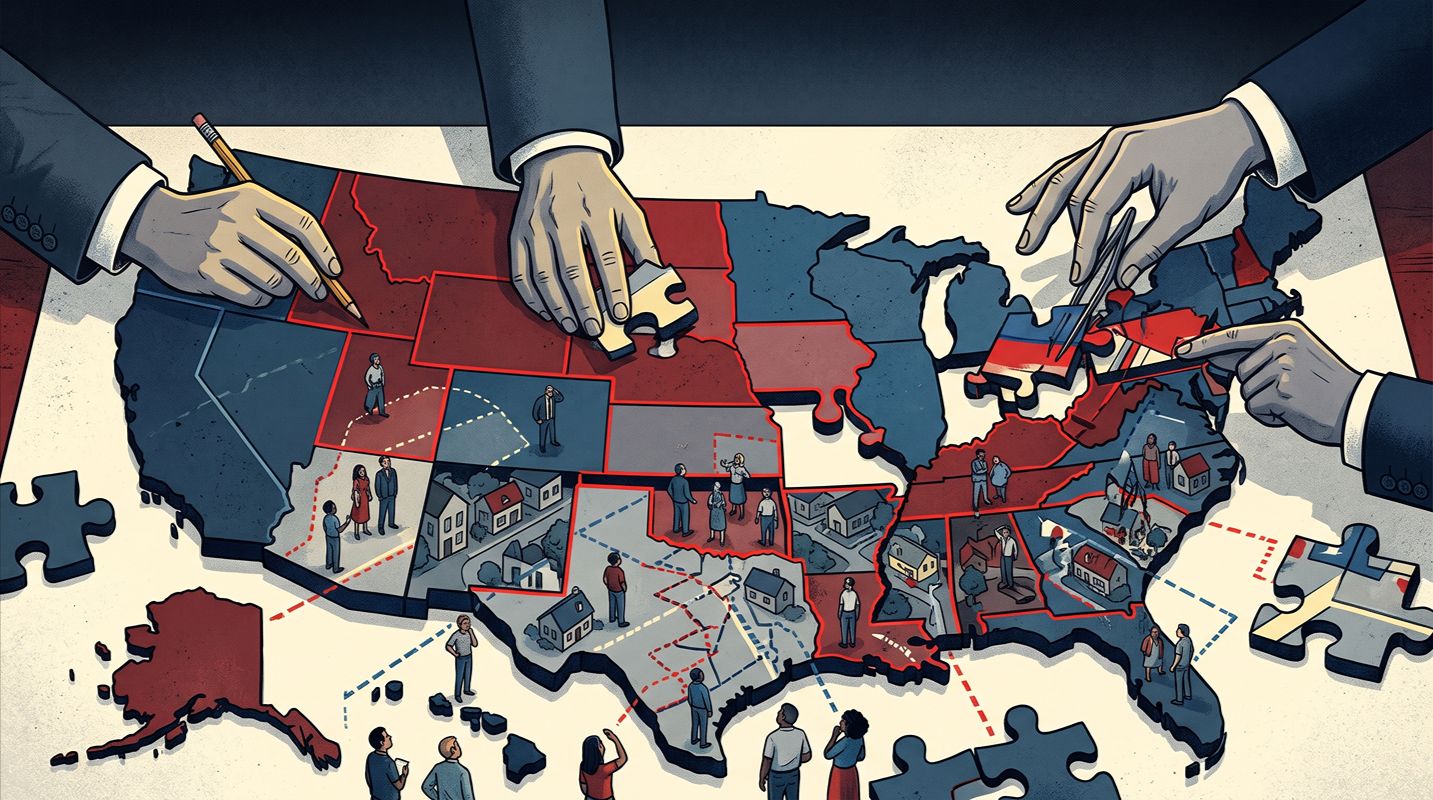
Political scientists call a map that backfires a dummymander. It happens when mapmakers get overconfident, carving up communities to thinly stretch their party’s advantage across as many districts as they can manage. Instead of settling for a few safe seats, they trade safety for volume, betting that voters will vote the same way they did before. That strategy relies on predictable behavior, but voting trends are always evolving.
Two weeks from Election Day, the mid-decade redistricting scramble may not deliver what its architects promised. The Washington Examiner reports that eight states redrew congressional maps this cycle to create 13 favorable new districts for Republicans, yet nonpartisan analysts estimate the GOP could flip only two to five seats. Democrats, meanwhile, could gain as many as six seats from redraws in California and Utah.
In Texas and Florida, Republican mapmakers banked heavily on recent conservative gains among Hispanic voters, treating election trends as permanent realignments. But a UCLA pollster told USA TODAY that Texas Republicans may have “overplayed their hand.”
Even so, a backfire is not a remedy. A dummymander is an embarrassment for mapmakers, yet communities were still cracked apart or packed together to hit a number. Hispanic families in South Texas were treated like a predictable bloc, not neighbors with their own kitchen-table worries. Both parties have drawn lines for advantage this cycle.
As my good friend and former colleague Chuck Todd recently noted on his popular podcast, playing this game undermines a party’s core brand of fairness, because partisan gerrymandering on either side yields hyper-partisan districts rather than healthy competition. The question for every map is the same: whose voice got diluted?
Louisiana shows what that looks like when the map holds. The Supreme Court’s April ruling in Louisiana v. Callais struck down the state’s 2024 map, and the Legislature then chose to replace it by eliminating one of Louisiana’s two majority-Black congressional districts. The new map largely restores the 2022 lines: five Republican-leaning seats and one Democratic-leaning seat anchored in New Orleans. Democratic lawmakers argued it would significantly deny Black Louisianans representation. Verite News in New Orleans, part of the Deep South Today network, covered the map as it moved through the Senate.
Louisiana shows what happens when maps hold as federal protections fade. The Supreme Court’s ruling in Louisiana v. Callais significantly weakened Section 2 of the Voting Rights Act, making it much harder to challenge racial vote dilution. Lawmakers then eliminated one of Louisiana’s two majority-Black congressional districts, significantly reducing Black Louisianans’ representation. Verite News in New Orleans, part of the Deep South Today network, covered the map smartly as it moved through the Senate.
Mississippi may be next. It hasn’t redrawn its congressional map for this fall, but Governor Tate Reeves has said lawmakers will redraw congressional and legislative lines before the 2027 election cycle.
Bottom line: When maps are drawn to pick voters instead of serve them, communities lose, even when the mapmakers lose too.